PMU vs Skin Camouflage – What’s the Difference?
When exploring cosmetic tattooing solutions, many people come across two terms that are often confused or incorrectly grouped together: PMU (Permanent Makeup) and skin camouflage. While both involve the use of pigment implanted into the skin, they serve very different purposes, require different skill sets, and deliver completely different outcomes.
Understanding the true differences between PMU vs skin camouflage is essential before committing to any treatment—especially if your goal is to address scars, stretch marks, or pigment loss rather than enhance facial features.
In this comprehensive guide, we’ll break down everything you need to know about PMU and skin camouflage, including how they work, who they’re for, realistic expectations, and why a professional consultation is critical—particularly for paramedical skin camouflage procedures.
What Is PMU (Permanent Makeup)?
Permanent Makeup (PMU) is a cosmetic tattooing technique designed to enhance facial features by mimicking the appearance of traditional makeup. Pigment is deposited into the upper layers of the skin to create definition, symmetry, and long-lasting color.
PMU is considered an aesthetic cosmetic service, not a corrective or medical procedure.
Common PMU Treatments
PMU is most commonly used on the face, including:
Eyebrows
Microblading
Powder brows
Ombre brows
Combination brows
Eyes
Lash enhancement
Traditional eyeliner
Winged or shaded liner
Lips
Lip blush
Lip neutralization
Full lip color
Each of these treatments is designed to enhance natural features, improve symmetry, and reduce the need for daily makeup application.
The Purpose of PMU
The primary goal of PMU is visibility.
PMU is meant to:
Be seen
Add contrast and definition
Highlight facial features
Create a polished, makeup-like appearance
Even when PMU is done with a “natural” aesthetic, it is still intentionally noticeable. Brows look fuller, lips appear more defined, and eyes gain subtle or dramatic emphasis depending on the client’s preference.
This is a critical distinction when comparing PMU vs skin camouflage.
How PMU Pigments Work in the Skin
PMU pigments are formulated specifically for cosmetic enhancement. They are designed to:
Heal true to color
Fade gradually over time
Retain definition rather than disappear into the skin
Because facial skin has different characteristics than body skin, PMU techniques are optimized for:
Thinner skin
Higher oil production
Frequent facial movement
Regular sun exposure
PMU results typically require:
An initial session
One or more perfecting sessions
Periodic touch-ups every 1–3 years
What Is Skin Camouflage?
Skin camouflage is also a cosmetic tattoo technique focused on reducing the visibility of skin irregularities, not enhancing features.
Unlike PMU, skin camouflage is not about adding contrast or definition. Instead, it aims to blend pigment into the surrounding skin tone to create a more uniform appearance.
Skin camouflage requires advanced training in:
Color theory
Skin physiology
Scar tissue behavior
Pigment dilution and layering
Long-term healing patterns
Inkless skin camouflage
Conditions Treated with Skin Camouflage
Skin camouflage is commonly used to improve the appearance of:
Surgical scars
Injury or trauma scars
Self-harm scars
Stretch marks (striae)
Vitiligo
Hypopigmentation
Skin graft areas
Post-procedure discoloration
These concerns often affect areas of the body where the skin behaves very differently than facial skin, making skin camouflage a highly specialized service.
The Goal of Skin Camouflage
The goal of skin camouflage is subtlety.
Skin camouflage is designed to:
Reduce contrast between affected skin and surrounding skin
Blend pigment seamlessly
Create the illusion of more even skin tone
Be difficult to detect once healed
Unlike PMU, successful skin camouflage should not draw attention.
When done correctly, people notice the improvement—not the tattoo.
PMU vs Skin Camouflage: A Fundamental Difference in Intent
The biggest distinction in PMU vs skin camouflage comes down to intent.
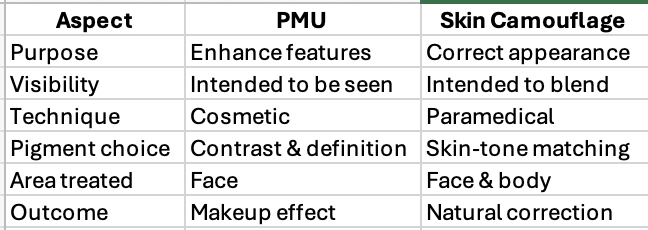
This difference is why practitioners trained only in PMU are not automatically qualified to perform skin camouflage.
Why Skin Camouflage Is Not “Just Tattooing Skin Color”
A common misconception is that skin camouflage is simply “tattooing skin-colored pigment into a scar.” In reality, it is far more complex.
Scar tissue and hypopigmented skin:
Absorb pigment differently
Heal unpredictably
Can change color over time
React differently to trauma
Skin camouflage requires:
Layered pigment implantation
Conservative saturation
Multiple sessions spaced months apart
Careful assessment of healing before proceeding further
This level of precision separates paramedical skin camouflage from standard cosmetic tattooing.
The Role of Consultation in Skin Camouflage
A consultation is important for any cosmetic tattoo procedure—but it is essential for skin camouflage.
Every scar, stretch mark, or pigment loss area behaves differently based on:
Age of the skin concern
Thickness of scar tissue
Location on the body
Skin tone and undertones
Circulation and elasticity
Sun exposure history
Underlying medical conditions
During a professional skin camouflage consultation, your provider should:
Evaluate the skin’s readiness for treatment
Determine if camouflage is appropriate
Discuss realistic outcomes (not perfection)
Explain how many sessions may be required
Review aftercare and long-term expectations
Unlike PMU, skin camouflage is not guaranteed to fully conceal an area. The goal is improvement—not erasure.
Why Realistic Expectations Matter
One of the most important conversations in PMU vs skin camouflage is expectations.
PMU outcomes are relatively predictable. Skin camouflage outcomes are variable.
While skin camouflage can dramatically improve confidence and reduce the appearance of scars or discoloration, results depend on:
How the skin heals
How pigment settles over time
How well aftercare is followed
Natural changes in skin tone
An ethical provider will never promise “perfect” or “invisible” results. Instead, they focus on measurable improvement and long-term skin health.
PMU Is Not a Substitute for Skin Camouflage
PMU techniques should not be used as a replacement for skin camouflage.
Attempting to camouflage scars or stretch marks with PMU pigments or cosmetic tattoo methods can result in:
Color mismatch
Uneven healing
Pigment migration
Increased visibility over time
This is why choosing the correct treatment—and a properly trained specialist—is critical when deciding between PMU vs skin camouflage.
Who Is a Good Candidate for Skin Camouflage?
You may be a good candidate for skin camouflage if:
Your scar is fully healed (typically 12–18 months old)
There is no active inflammation or keloid formation
Your skin condition is stable
You understand that improvement varies
You are willing to commit to multiple sessions if needed
A consultation is the only way to determine candidacy accurately.
Choosing the Right Professional Matters
Because skin camouflage is a paramedical service, experience and training matter more than aesthetics alone.
When researching providers, look for:
Specialized training in paramedical tattooing
Experience with scars and pigment disorders
A thorough consultation process
Conservative, realistic treatment plans
Before-and-after results on healed work (not fresh)
Final Thoughts on PMU vs Skin Camouflage
Although PMU and skin camouflage both involve pigment and tattooing, they serve entirely different purposes.
PMU enhances and defines facial features
Skin camouflage reduces the appearance of skin irregularities
Understanding this distinction helps protect your skin, your investment, and your long-term results.
If your goal is to improve the appearance of scars, stretch marks, or pigment loss, skin camouflage—performed by a trained professional—may be a powerful, confidence-restoring option.
Ready to Take the Next Step?
Schedule a consultation to learn whether skin camouflage is appropriate for your skin.
A personalized consultation allows you to explore your options, understand realistic outcomes, and receive expert guidance tailored to your unique skin and goals.
FAQs: PMU vs Skin Camouflage
What is the main difference between PMU and skin camouflage?
The main difference between PMU vs skin camouflage is their purpose. PMU enhances facial features like brows, lips, and eyeliner and is meant to be visible, while skin camouflage is a paramedical cosmetic tattoo technique designed to blend pigment into the skin to reduce the appearance of scars, stretch marks, and pigment loss.
Can PMU be used to cover scars or stretch marks?
No. PMU should not be used to cover scars or stretch marks. PMU pigments and techniques are intended for facial enhancement, not scar tissue. Skin camouflage requires specialized paramedical training and custom pigment blending to achieve safe, natural-looking results.
Is skin camouflage the same as tattooing skin-colored ink?
No. Skin camouflage is not simply tattooing skin-colored ink. It involves advanced color theory, layered pigment application, and specialized techniques to account for how scar tissue and hypopigmented skin heal and retain pigment over time.
Does skin camouflage completely remove scars or vitiligo?
No. Skin camouflage does not remove scars, stretch marks, or vitiligo. It improves their appearance by reducing contrast between the affected area and surrounding skin. Results vary based on skin type, condition, and healing response.
Why is a consultation required for skin camouflage?
A consultation is required because every skin condition responds differently to pigment. Factors such as scar age, texture, location, and skin tone affect outcomes. A consultation helps determine candidacy, set realistic expectations, and create a personalized treatment plan.
How many skin camouflage sessions are needed?
Most clients require multiple sessions spaced weeks or months apart. This allows the skin to heal fully between treatments and ensures pigment is layered conservatively for the most natural-looking results.
Who is a good candidate for skin camouflage?
A good candidate has fully healed skin, no active inflammation or keloid scarring, and stable pigment loss or scarring. Candidates should understand that results vary and that improvement—not perfection—is the goal.
How do I know whether PMU or skin camouflage is right for me?
If your goal is to enhance facial features, PMU may be the right option. If your goal is to reduce the appearance of scars, stretch marks, or pigment loss, skin camouflage may be appropriate. A professional consultation is the best way to determine which treatment suits your needs.
Ready to Explore Your Options?
Schedule a consultation to learn whether skin camouflage is appropriate for your skin.
A personalized evaluation is the first step toward realistic, natural-looking improvement and renewed confidence.